
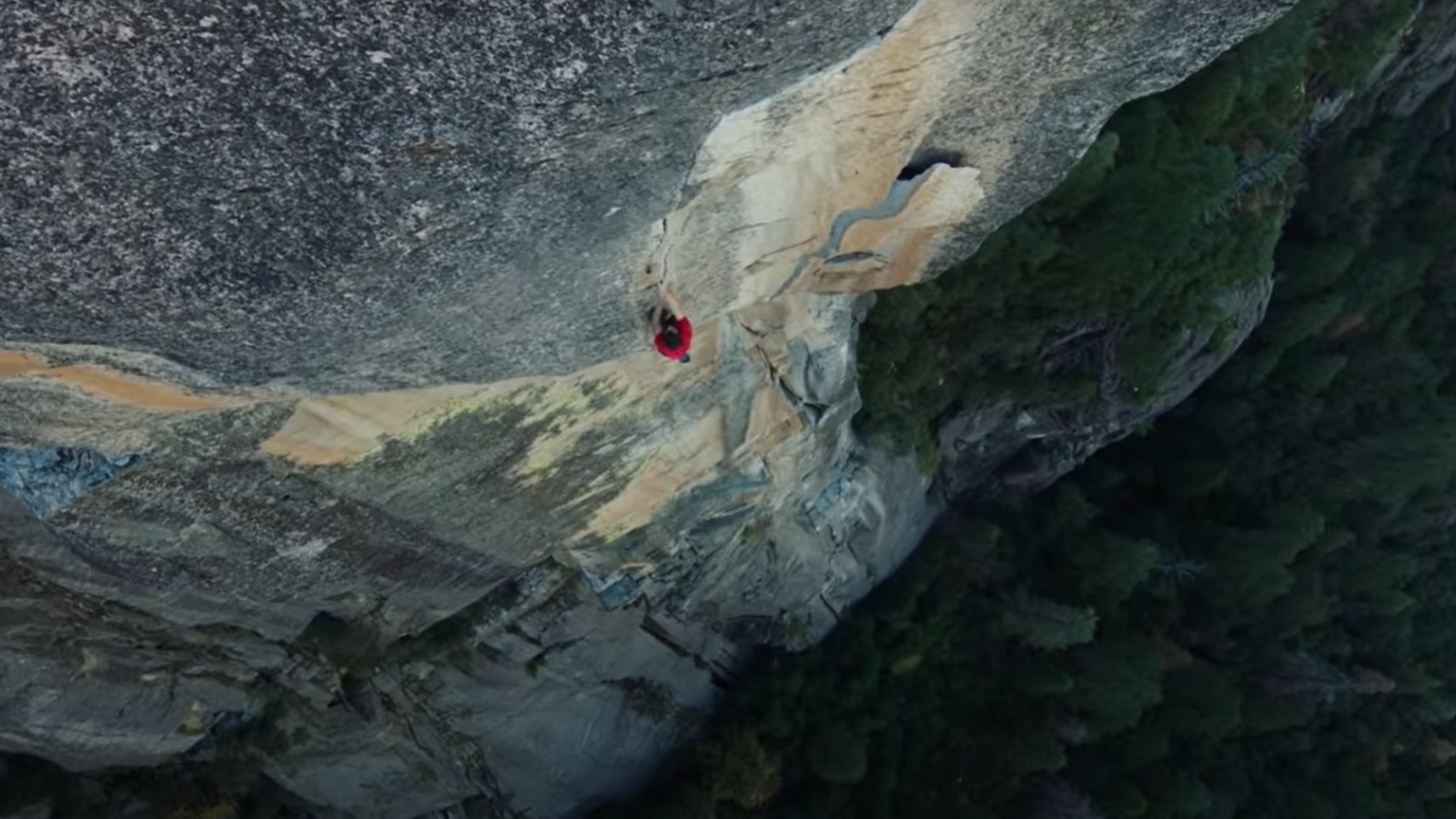
“There is no adrenaline rush. If I get an adrenaline rush, it means that something has gone horribly wrong.“
—Alex Honnold
Most people look at a sheer rock face and see an impossible hazard;
Alex Honnold looks at it and sees a problem to be solved
A View of the Possible
Since I was a little girl, I was captivated by explosive body actions and gross motor skills—jumping, climbing, running, conquering mountains. However, I was operating within a restricted physical system: severe asthma, in an era before rescue inhalers even existed. Compounding this was a rigid social construct that labeled these movements as exclusively for boys. My asthma inadvertently spared my mother the social friction of a daughter defying the gendered expectations of the time, labels I now recognize as narrow constraints on human potential, such as the offensive qualifier: a “tomboy.”
Yet, my fascination with high-performance physical execution never waned.
Consider Alex Honnold. He executes free-solo climbs, ascending immense vertical faces entirely decoupled from safety ropes. To the casual observer, the sheer verticality triggers immediate vertigo, creating a cognitive perception that a fall is inevitable.
When an elite athlete balances high-stakes performance with family life, outsiders often view it as a conflict of interest, assuming extreme exposure is a reckless deviation from security. However, looking through a critical lens, we can see this not as a failure to prioritize safety, but as a choice between two entirely different operating models. We are observing a highly specialized system of mastery. One where volatility is not an oversight, but a precisely calibrated variable integrated into a life lived at the absolute limits of human capability.
Is he reckless, or has he simply mastered the operational variables to the point that the actual probability of failure is far lower than the extreme environment suggests?
My vantage point is shaped by a lifetime in sports and an appreciation for what human mechanics can achieve. Having raised an international gymnast, I have seen firsthand how individuals systematically push themselves to do the extraordinary. This isn’t about raw passion; it is about a highly specialized understanding of how movement systems and exposure actually interact.
Furthermore, risk management is a core discipline of my professional work. I have engineered and managed critical, complex projects where rigorous system assessment is not optional; it is a foundational requirement.
When I look at these athletes, I don’t see recklessness. Because of my background in high-level sport and complex project systems, I see the skill and the precise calculation. I understand the execution matrix because I understand the mechanics behind it.
The Mirage of Danger: Perception vs. Execution
Perception of risk is our own intuitive assessment of the probability and severity of harm, shaped by cognitive, emotional, and social factors rather than strictly by objective, statistical data. In practice, people often conflate the risk with the penalty, viewing “risk” as merely the impact of a negative consequence without applying critical thinking to systematically analyze all the elements that feed into the system.
Let us isolate what this data actually represents.
While modern standards like ISO 31000 define risk dynamically as “the effect of uncertainty on objectives”—noting it can yield positive opportunities or negative threats—for this analysis, we are focusing strictly on negative outcomes and system failures.
Importantly: risk is not what could happen.
True risk requires analyzing both the statistical chance of an event occurring and the absolute impact of its consequences, expressed either mathematically or qualitatively.
This introduces relativity. The level of exposure is never an absolute; it is entirely dependent on context, perspective, and points of comparison. The exact same event or activity will be assessed as a high or low vulnerability scenario depending on the variables of the situation.
By definition, risk is the product of likelihood (ranging from rare to almost certain) and the severity of the consequence (ranging from negligible to catastrophic).
The Constant: The Gravity Constraint
The consequence of falling during a free-solo climb is an absolute, unyielding constant: it is catastrophic. For Alex Honnold, for me, or for anyone else, the penalty of a fall is identical. Gravity at does heights does not negotiate; the outcome is death.
And this is exactly where the standard observer’s critical thinking stops. They freeze at the consequence. They fall into the cognitive trap of believing that because the consequence is catastrophic, the risk itself must be universally extreme.
The Variable: Statistical Tolerance
But what is the actual likelihood that Alex Honnold falls from a free-solo climb? What is the real probability that allows us to accurately calculate his level of exposure? Is it rare? Unlikely? Possible? Likely? Almost certain?
It is, of course, physically possible that he falls. But given the data, it is fundamentally incorrect to call it likely, let alone almost certain.
If I attempt that same rock face, system failure is not just highly probable; it is an absolute certainty. 100%. I possess zero baseline practice, no specialized experience, inadequate grip strength, and my core stability is not winning any awards. To complete the profile, psychological panic would set in. Other professional climbers might possess the raw physical power and thousands of climbing hours, but lack free-solo specialization. Others may have the experience but lack the required psychological command. Others simply do not possess that internal drive, or choose not to accept that specific environment—which is perfectly fine.
The purpose here is not to compare climbers, but to highlight how likelihood is variable, making risk relative.
If we process this through my preferred critical thinking framework, the Ladder of Inference, a tool I have relied on for over 20 years, we can deconstruct how Honnold operates. He observes, selects, and analyzes the hard data of his training, execution history, and real-time physical health. He forms objective assumptions based on that data, draws conclusions regarding his exact operational capacity, establishes what the real exposure is, and only then decides to act.
If an outside observer places Alex’s climb onto a standard risk matrix—estimating the likelihood from their own perspective as “possible” against a “catastrophic” consequence—the matrix flags the activity as an extreme risk. But Alex holds the actual telemetry. Because he knows his precise capabilities, he may very well evaluate his likelihood as “unlikely.” That single shift recalibrates the final assessment from an extreme risk to a moderate one. It remains a calculated exposure, but it is no longer an uncalibrated hazard.
Aren’t we guilty of measuring his reality using our own cognitive biases? Are we projecting our own lack of knowledge, our own physical limitations, and the emotions those limitations generate? Are we falsely viewing the risk as nothing more than its consequence?
The true likelihood of a system failure depends almost entirely on variables within the operator’s control: physical grip strength, deliberate practice, compounding experience, specialized expertise, and psychological mastery. To a much lesser extent, it depends on unmanageable environmental variables, like sudden weather shifts—a variable mitigated by waiting for a perfect operational window.
Therefore, the likelihood is directly tied to Honnold’s highly optimized system. He knows exactly what he can execute because he has spent decades refining the mechanics. No one is claiming he cannot fall. He can fall. But the probability of that event decreases with every pound of grip strength he develops. It decreases with the thousands of hours invested on hangboards, campus boards, and perfecting movements on the rock. The likelihood drops systematically as he trains his mind to maintain absolute cognitive control.
System Calibration: Managing the Exposure
Even when likelihood is minimized to “unlikely,” a scenario with a catastrophic consequence demands a clear mitigation architecture. If we look at the four standard protocols for risk management—Avoid, Reduce, Transfer, or Accept—how does an elite system respond?
- Avoid: He chooses not to avoid the environment, as execution is the objective.
- Reduce/Mitigate: He takes exhaustive measures to minimize the likelihood of an occurrence. However, he cannot reduce the severity of the consequence. If he falls, he dies; a helmet or a change in apparel cannot mitigate a 3,000-foot gravity drop. Ropes are omitted by design.
- Transfer: The exposure cannot be transferred. It is entirely his own.
- Accept: This is the core of the system. Alex systematically analyzes the variables, calibrates his readiness, and accepts the remaining exposure.
Honnold’s physical metrics are extraordinary. His grip strength allows him to execute pull-ups using only his fingertips; his core strength is brutal; his flexibility is precisely tuned to place his body exactly where the rock demands. His nutrition, recovery, and sleep are carefully synchronized with his operational needs.
He processes all of these variables, and the data tells him: today is the day, or today is not the day.
Consider his first attempt to free-solo El Capitan. After climbing a portion of the route, his internal telemetry did not match the required thresholds. His critical thinking overrode his momentum. He analyzed the active variables, recognized that the likelihood of an error had crossed an unacceptable line, and concluded: today is not worth the risk. He bailed out. On that day, he AVOIDED the risk.
But the day arrived when every single variable was in check. Honnold returned to El Capitan and executed his plan, ascending the 3,000-foot (~900 meters) granite monolith on June 3, 2017, in 3 hours and 56 minutes. Nearly a decade later, on January 25, 2026, he applied the exact same system to free-solo Taipei 101, a 1,667-foot (~500 meters) skyscraper, navigating its structure in 1 hour and 31 minutes.
Flawless execution. Zero ropes.
Was he reckless?
The Logic of the Extraordinary
This analysis is not meant to praise, judge, or critique Alex Honnold’s personal choices. It is his life, and he owns it. His climbs simply serve as a perfect, high-fidelity case study for risk assessment.
The data points to a clear answer: No, he was not reckless.
He steps onto the rock only after he has drastically minimized the likelihood of failure, and consciously accepted the baseline reality of the gravity constraint.
His execution relies on a massive repository of capability built over thirty-five years, starting when he was five years old. It is backed by thousands of hours of deliberate practice, navigating failures, learning what holds fail and what movements succeed, evaluating real-time data, and understanding true risk as the precise combination of likelihood and consequence. Through rigorous critical thinking, he systematically alters the variables he can control to suppress the likelihood of a catastrophic event.
Risk is never a static, fixed value. It is a dynamic equation that shifts based on context, perspective, and the unique capabilities brought to the endeavor. In the case of an elite athlete, mastery is the ultimate variable that recalibrates the entire calculation.
When both the likelihood and the severity of a consequence are high, the system is in extreme jeopardy.
When the consequence is catastrophic, we must invest everything within our power to drive the likelihood down to its absolute minimum.
Conversely, if we know an event is likely or almost certain to happen, we must engineer the system so that the consequence is as low as possible. If the consequence remains catastrophic under those conditions, the entire strategy must be rejected.
The safest configuration is always one where both likelihood and consequence are low, reducing exposure to a negligible level. When exposure rises to moderate or high, a deliberate mitigation architecture must be deployed: Can we avoid it, reduce it, transfer it, or accept it?
Every single component that influences risk must be stripped down and analyzed. Critical thinking provides the discipline to observe, select, and process objective data. From that data, we form accurate assumptions and arrive at sound conclusions, enabling us to accurately define our exposure and make calculated choices.
Without this structured data analysis, our uncalibrated perception of risk will override objective measures, distorting our decisions. Our choices depend on the risks we face—but those risks are relative. To navigate them successfully, we must first master the variables that define them.
————————————-
Photo Attribution: Fox Sports, CC BY 3.0 <https://creativecommons.org/licenses/by/3.0>, via Wikimedia Commons