
“It is not the mountain we conquer, but ourselves.” — Sir Edmund Hillary
Project Overview
In the summer of 2019, Alejandra and I embarked on a six-day backpacking journey to honor the memory of Diego, my son and her beloved brother, on the first anniversary of his passing. As mother and daughter, we approached the trip with deep respect for the mountains and for the meaning behind the journey, knowing it deserved the same care and discipline as any other project.
Drawing on our professional project management skills, we planned the trip in detail and approached it with intention, structure, and adaptability. The journey became more than a personal tribute. It demonstrated how careful planning and disciplined execution can create an experience that is meaningful, sustainable, efficient, and repeatable, laying the foundation for future annual expeditions.
The Challenge
Although we were experienced backpackers on tropical mountains, we were not adept at hiking in the mountains of the Pacific Northwest and knew very little about what would be needed for the journey. There were many unknowns, and our respect for the mountains made clear that assumptions would not be enough.
We needed to understand the route, terrain, weather conditions, equipment requirements, and contingency options well enough to prepare responsibly. That included planning for unforeseen disruptions. When a trail closure caused by pouring rain forced a change the night before
THE STRATEGY
We approached the trip using a project scoping methodology that had guided us through many personal and professional challenges.
While the methodology remained consistent, we adapted it to fit the size and complexity of a hiking trip, which naturally differs from an aerospace project or other large-scale effort. As a result, several project elements were scaled and adjusted to suit the specific situation.
As we planned our expedition, we took on the roles of project managers, dividing responsibilities and tackling each task as it arose.
Our brainstorming sessions revealed three major constraints: time, distance, and weight. The trip had to span six days and five nights, stay within state lines, maintain a specific daily mileage to ensure we enjoyed the trek without overexhausting ourselves, and our packs had to remain light enough for the stretches between campsites when we had to carry all our gear.
We knew we had to carefully consider every aspect, from food and water to shelter and logistics.
Research & Planning
Research became our greatest ally. We delved into the state’s trail association, studied weather patterns, learned about wildlife and local plants, and determined how to access clean water on the trail.
Gear, meals, permits , every detail was meticulously researched and analyzed.
And speaking of wildlife: bears, my oh my! We had never dealt with that aspect before, so there was learning to do—from using a bear vault and bear spray, to speaking loudly and making ourselves big.
Though we lacked personal connections to seasoned hikers, the vast expanse of resources became our virtual mentor. REI, our quintessential outdoors store in the PNW, provided a guidance proved to be invaluable. We heeded their advice and lessons, on selecting the best or most practical options for certain aspects of the trip. With patience and critical thinking, we navigated through a sea of information, ensuring we made informed decisions every step of the way.
But it was Craig Romano who was the ultimate guide and mentor. In his book, Backpacking Washington, he provides the details of 70 overnight and multi-day routes—including distance, type of route, level of difficulty, best season, how to get there, and specific trail details along the way.
Our constraints narrowed the possibilities, and from those options, our final route was selected, along with a backup plan for for contingent risks.
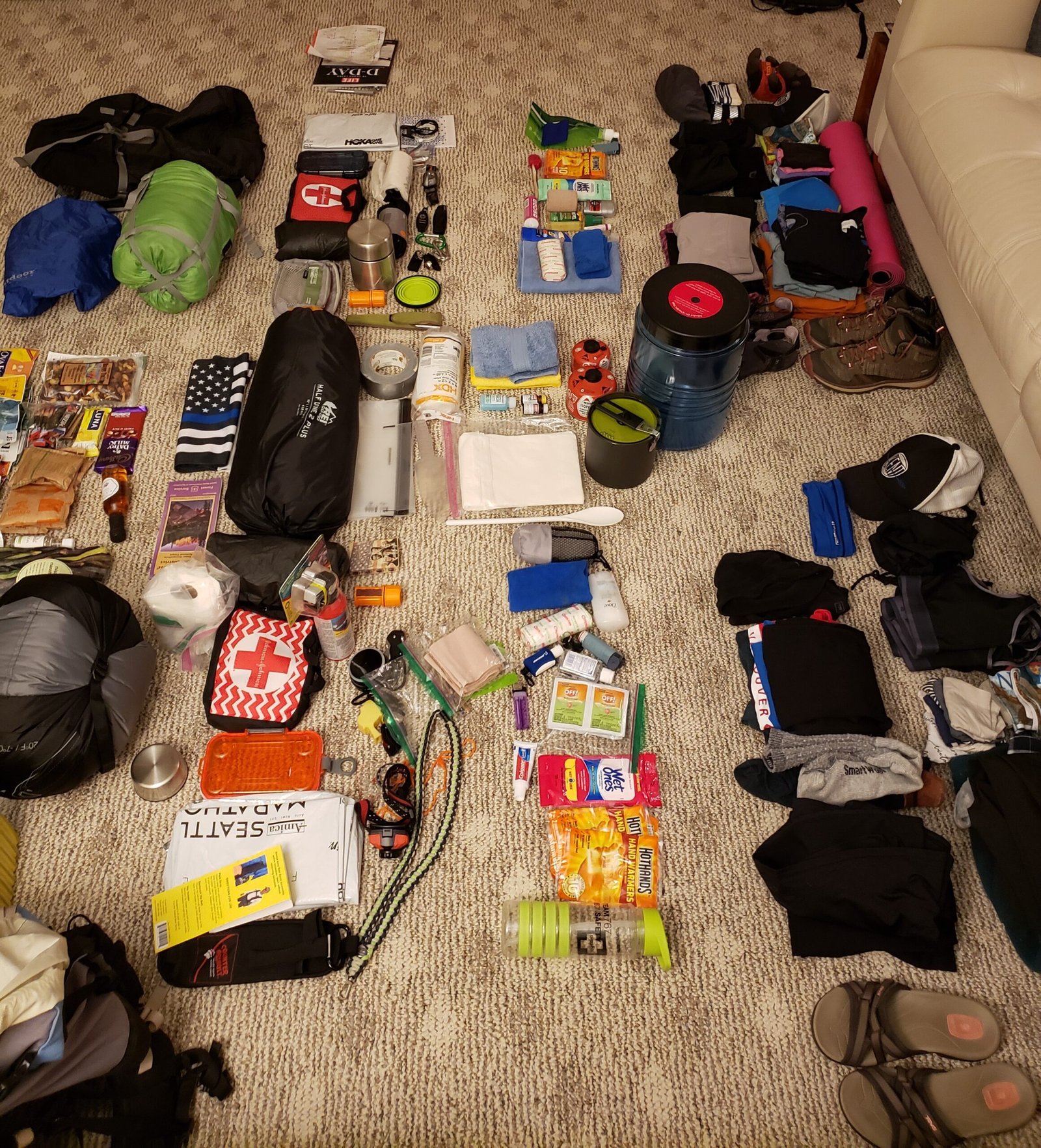
Nothing escaped our backpacking ecosystem–a system broken down into distinct categories: water, food, shelter, first aids, clothing, toiletries, work items, vehicle/fuel, accessories.
Each of these categories was meticulously detailed. Food, for example, was split into breakfast, trail mix/snacks, high-carb dinners, coffee, and even sweets, despite the legendary (and real) sniffing powder of local bears.
The gear? It’s the PNW in the summer. It could be hot during the day, but it will certainly be freezing at night, so we had to be prepared for the full spectrum of weather.
After compiling an exhaustive list of 87 items—some for guaranteed daily use and others for just-in-case survival—with our location locked in, and our hearts and legs eager to hit the trail, we were ready.
Back-up Plan & Pivot
Our thorough planning set the stage for flawless execution. Yet, as with any journey, obstacles can emerge, which is why our strategy included a backup plan for contingencies.
Because we arrived late on the first evening—exactly as planned—it was too late to safely begin a long hike, so we set up at the trailhead campground. Just as we got settled, happy to finally be immersed in the experience, it started to pour.
Listening to our gut instincts, we decided to bypass the tent and sleep directly in our rig instead—which turned out to be the best decision we could have made.
While July is historically the driest month of the year in the PNW, that day was hit by an uncharacteristic weather system that brought steady rain, mist, and heavy downpours right into the Cascades and the Snoqualmie region.
The following morning, the entire campground was completely swamped. A neighboring camper came over and told us, “I’ve camped my entire life, and this was the worst rain I’ve ever seen. In the middle of the night, I was out there with my kids, desperately scooping water out of the trenches around our tent.”
Hearing that, Alejandra and I couldn’t have been happier that we trusted our intuition the night before.
We had our first breakfast of the journey, picked up everything, locked our rig, and hit the trailhead only to discover our chosen path was just closed due to landslide concerns.
But as risks were evaluated as part of the planning, we had a backup plan: Plan B.
But plan B was not next door. Plan B was far. The reason that it was the second overall choice is that fully satisfied our constraints and baseline experience.
Undeterred, we swiftly adapted, and moved to follow the alternative trip which was hours away. Armed with a new map, we pressed on, adjusting our plans for the day but maintaining our resolve.
Throughout our journey, we leaned on the procedures we had established–from meal preparation to campsite setup–allowing us to seamlessly pivot to our new destination.
Each challenge became an opportunity to put our problem-solving skills to the test, confident in our ability to overcome any hurdle.
As we reached the end of our six-day trek, exhaustion mingled with a profound sense of accomplishment.
The trip became about more than the logistics. It was about absorbing the small details: the murmur of the river running alongside the trails, the light filtering through the leaves, smelling each of the flowers that welcomed us on our journey, and simply having the time to share those moments.
Amidst the breathtaking scenery and shared moments of reflection, we felt a sense of peace wash over us, knowing we had honored Diego’s memory in a way that was both meaningful and profound.
THE RESULTS
Reflecting on our experience, we uncovered invaluable lessons learned along the way. From the significance of thorough research and planning to the importance of adaptability, our journey illuminated the power of determination and resourcefulness in overcoming challenges.
Our six-day hike encapsulated the essence of the journey itself, encompassing highs and lows, moments of laughter and tears, and fostering an indelible bond that sustained us.
Returning home, we carried not just memories of our travels, but also a newfound strength and resilience that would endure.
As we do this backpacking trip every year on Diego’s anniversary, our meticulous planning proved its worth. By establishing processes and requirements upfront, subsequent trips became easier to plan.
What was once a weeks-long preparation had now condensed into a handful of days—a testament to the efficiency we had honed over time. The only major variable that changes each year is the location.
We thoroughly audit our gear list for each trip, stripping out what isn’t necessary (like a bear vault, depending on local regulations) and adding specific items that the new terrain requires.
Our journey underscored how crucial it is to be ready for anything, because almost everything comes down to the planning.
Our preparation was so thorough that even when the main aspect of the trip—the location itself—changed, we could shift swiftly.
The pivot wasn’t a challenge; it was just a smooth transition because the planning and research were already done.
PROJECT IN NUMBERS
- # of days/nights: 6 days, 5 nights
- # of Key partners: 2
- Target Pack Weight Capacity: 35 lbs maximum per person
- Total Resource Inventory: 87 items packed (comprising individual gear, shared utility assets, and survival essentials). Due to the mountain conditions, many items were packed “just in case”; thus, despite some of them not being used, they still must be included in the list.
- Route Deviation Delay: 7 hours added due to travel to the alternative location
- Planning-to-Execution Ratio: While the exact numerical ratio was not formally tracked, the planning phase was exceptionally comprehensive. Because the backpacking trip demanded absolute self-sufficiency and critical safety precautions in an unfamiliar mountain environment, our lack of baseline regional knowledge drove us to a level of thorough planning that far exceeded the actual duration of the trek.
- Encountered Bears: 0